

The Lycians
Who were the Lycians? It’s a good question… and not one with an easy answer.
The records of these ancient people aren’t as detailed or numerous as their contemporaries. There are a lot of assumptions that need to be made when putting together a clear picture of the Lycians.
It’s a question worth asking as a visitor to Turkey, though.
The ruins of their civilisation are spread out across a significant part of the country and the sites are an important part of any historical tour of the region.

What we do know is that they lived in the area which is now central Turkey, stretched between Antalya and Fethiye from at least 1500 BC (although probably from much earlier) until about the 6th century AD.
Their location put them right at the nexus of Greece and the Eastern world – and this meant they picked up influences from both sides.
Unlike most groups during this period, the Lycians were not barbaric. They were actually respected for having an extremely stable form of democracy within their political structure.
Not only were they unusually harmonious internally, but they managed to avoid too many major conflicts with their neighbours.
They have been compared to the Swiss of today: wealthy, hard-working, neutral but defensive.

Xanthos-Letoon, Turkey
Even today, the capital of Lycia gives you the impression that this was a civilisation that was able to do things on a grand scale.
The twin sites of Xanthos and Letoon are only about 60 kilometres from Fethiye but are slightly tricky to get to if you don’t know what you’re doing.
They are not an obvious stop for tourists passing through although tour buses of Turkish locals are more likely to stop there.
It’s a pity, because both locations (which are about five kilometres apart and I easily walked between) have a lot to offer.
Not only are they an interesting insight into the Lycian culture but also they show the influences that came from both the west and east.
So, here in photos, are some of the highlights of the two sites.
The amphitheatre at Letoon:

The temple of Artemis in Letoon:

The nymphaeum at Letoon:

The amphitheatre at Xanthos:

The ‘Harpy tombs’ at Xanthos:

The hill tombs at Xanthos:

THE BEST ACCOMMODATION IN FETHIYE
You’ll find a lot of accommodation along the coast and in the blocks back towards the centre of town.
BACKPACKER
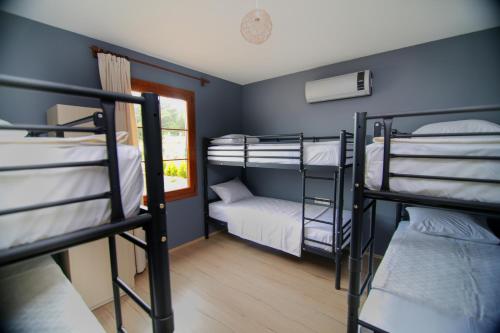
For a fun hostel that’s welcoming of all types of travellers, I would recommend Chillsteps.
BUDGET

You’ll often get great deals for the rooms at the lovely Infinity Exclusive City Hotel.
BOUTIQUE

For something a bit special, have a look at Ece Hotel Sovalye Island just off the coast of Fethiye.
LUXURY

And there are some beautiful luxury hotels but I think one of the best is Yacht Classic Hotel.


I remember learning about the Lycians in my World Civ class in college. Until I read this, I had forgotten most of it:)
That must’ve been a pretty detailed class if they were telling you about the Lycians. I don’t think we even came close to learning about them at school. Or maybe I’ve just forgotten too 🙂
My friend always says the Lycians were “them clever dudes!”
Ha ha – that’s a perfect description of them from what I know!
For a brief short moment I hoped this was going to be a post about Kate Beckinsale fighting werewolves whilst clad in tight PVC. Ah well.
Ha ha ha… I’m so sorry to disappoint!!! 🙂
Very interesting, it always fascinates me to explore these ancient populations and try to connect them to each other. When I researched Lebanon’s Phoenicians I loved finding out they had commercial ties with our own nuragic civilization in Sardinia. It would be very interesting to see who Lycians had links and relations with.
I think the Lycians are a group that would have had a really interesting history. I’m sure there’s a lot more research I could do about them, but it’s a pity there aren’t as many records of their civilisation as there are others of the time.
Ohh, I would love that place! History, and more history!
Definitely a good place for the history buffs… at least a good starting point to find out more about the Lycians.
The Lycians were an interesting group in history. Known for their slings if I remember right.
Seriously? Their slings? I didn’t know that… although clearly there’s a lot that I don’t know about them…
Loved the photos!
Thanks!
Great pics! I am thinking of walking the Lycian way next year and this was great motivation! I included it in my weekly roundup here: http://vagabondette.com/weekly-roundup/weekly-roundup-september-12-2012/
Walking the Lycian way sounds more and more interesting, the further I investigate it. It was extremely hot when I was there in August, though. I wouldn’t want to be trekking along in that weather!
No, it is definitely not a summer activity!
Perhaps Read ATULYA K BINGHAM”s Ashe”s trail (2014) a good read… & it really feels like she describes when you are over there..
Great info, dude! I don’t know much about the Lycians. I definitely have to make it to Turkey one day. These ruins are spectacular. We would love to be able to spend at least a month in Turkey when we do go. Great photos.
Thanks! There’s a lot more to discover about the Lycians than I saw. It’s definitely worth delving into their history and culture a bit when you’re there.
Historic tours have always fascinated me as they open an opportunity to unravel the past. These are some beautiful stills here. These ruins are suggestive of the fact that the Lycians believed in aesthetics, creativity and art.
You’re right – the Lycians clearly had a deep understanding of aesthetics. From everything I’ve read, they seemed like a very advanced group of people.
According to some recent theories the Lycian land was inhabited by migrating ancestors of todays Serbs/Croats from the area of Lika witch still exist today. The old name of Xhantos was Sirbin according to Strabon. Sirbin was the name used for Serbs (a general name for all Slavs actually in that time) in the ancient time because they inhabited all lands north of Greece in many different clans (illyrian, thracian, panoinian, etc). So what a hell the Serbs are doing there? At this moment the theory has shown major genetic similarities of the Dinaric Serbs/Croats with them. It seems they migrated from.the Danube delta to.these area before any Greeks (Greeks calles them barbarians when encountered them) Christian Orthodox priest Svetislav Bilbija has translated this Sirbin text of the obelisk using old Serbian cyrillic (Srbica) and found that the text is a codelaw meant for Serbs/Sirbians, the inhabitants. It contains rules about governnace, family, enemies etc. On the translated text the name SRB accurs few times witch cannot be a coincidence. Why these info is still not available in wider western public i have no idea but in combination of recent findings of the extent of Danube civilization, their writing and culture that predates anything known to man today is a revolution in history and archeology. If you need info let me know on morskisrle”SIGN”hotmail.com Cheers.
I greet you Sasha and your writing. Let me add something: Mr. Bilbija wrote mostly about Etruscans and he proofed that Lycians and Etruscans are the same people who use same language and same transcript. Nowadays genetic is evidencing it I2 genetic is oldest one in Europe.