

My guide, Azret, is pointing up at the rippling ribs of rock that flow down the limestone cliff like petrified white-water rapids.
Gesturing up at two dark cavities amongst the deep frozen furrows, he smiles at me and says, “I call this one gorilla nostrils”.
From the vast blindingly-white flatness of the Tuzbair Salt Pan, I scramble up the cliff face in the heat, almost losing my balance, right into those gorilla nostrils. From here, I can see they’re actually created by a massive stone arch. From here, the view for kilometres across the whiteness is surreal.
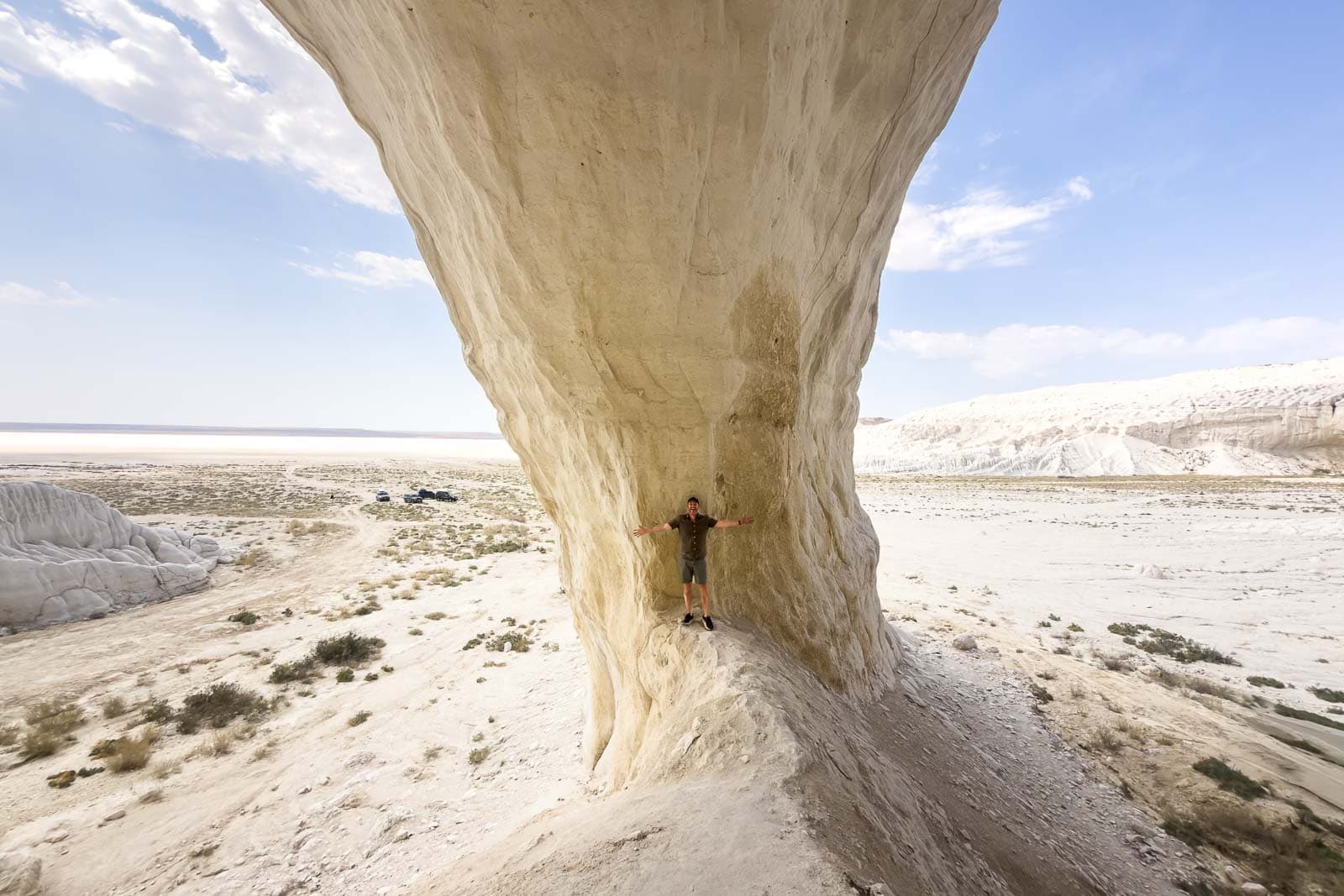
Welcome to Mangystau, a region in the very west of Kazakhstan, where you’ll find some of the country’s most incredible landscapes.
The best way to visit the deserts of Mangystau is with a guided 4WD tour. I recommend this fantastic tour, which includes three days in Mangystau.
As a country, Kazakhstan can already feel a bit disconnected from the main tourist trail, but Mangystau takes this to another level.
An extreme untamed desert of sunken canyons, chalk escarpments, and towering limestone monoliths. People often describe it as ‘Mars on Earth’ or a ‘moonscape’ – and I can see why. It really is out of this world.
The best Mangystau itinerary takes you to a variety of these sites to see the different rock forms, their rainbow of colours, and they way they change with the light or the viewpoint.
But because the logistics of travelling here independently are notoriously tough, exploring this alien frontier is best done on a multi-day 4WD expedition from the coastal city of Aktau.
I think three days in Mangystau is the right length of time, because there’s a fair amount of driving on these dusty bone-rattling days. But if your trip is anything like mine, you’ll find yourself watching wild horses gallop across valleys beneath castle-like mesas, exploring ancient underground mosques, and maybe even finishing the day with a sharp swig of camel milk at a yurt camp.
It’s a raw spectacular adventure that is yet to be stitched into the main itineraries of travellers. So here’s what you can expect.
Why visit the Mangystau region?
There are easier things to do than a Kazakhstan desert tour. Mangystau is a long way from most places, the region is vast, and there’s little tourism infrastructure. But this is exactly why it’s such an incredible place to visit right now.
Mangystau offers the kind of raw and unfiltered adventure that is becoming increasingly rare. There’s no fear of overtourism here – although there are enough tour companies to make your trip easy to organise, you may feel like you’re the first person to discover it.
Why does the Mangystau landscape look so unusual?
Millions of years ago, this entire region sat at the bottom of the ancient Tethys Ocean. As the waters receded, eons of relentless wind and rain carved the exposed chalk and limestone seabeds into the surreal canyons, salt flats, and alien monoliths you see today.
What are the best things to see in the Mangystau region?
The undisputed highlight is the Bozzhyra Tract with its soaring limestone fangs, followed closely by the blinding white expanse of the Tuzbair Salt Flat. Other must-see stops include Kyzylkup (Tiramisu Canyon), Mount Sherkala, and the Torysh Valley of Balls.
Can you see the best sights of Mangystau on a day trip from Aktau?
You can reach closer landmarks like Sherkala or the Valley of Balls on a long day trip, but the most spectacular landscapes like Bozzhyra and Tuzbair are too deep in the desert. The best option is to join a tour like this three-day trip through Mangystau.
Of course, it’s not just about the sense of adventure. The environment here is also a main attraction, with the landscapes one of the main reasons to visit Mangystau.
This is an alien region carved out of an ancient ocean. When the water receded millions of years ago, it left behind a surreal topography of blinding white salt flats, towering limestone fangs, and deep canyons striped in pastel colours.
It’s a place where you can stand on the edge of the Ustyurt Plateau and look out over a depression so immense and bizarre it feels like the surface of Mars… yet with absolute silence and no other tourists in sight (which I guess it also what you’d get on Mars).
In other words, visiting Mangystau isn’t a relaxing getaway, it’s an expedition, and it rewards travellers looking for scale and spectacle.
The Mangystau route at a glance
When you’re looking at planning a Mangystau itinerary, there is no single obvious way to do things. You’ll likely have to do some backtracking or skip some of the sights. I think that’s good and bad.
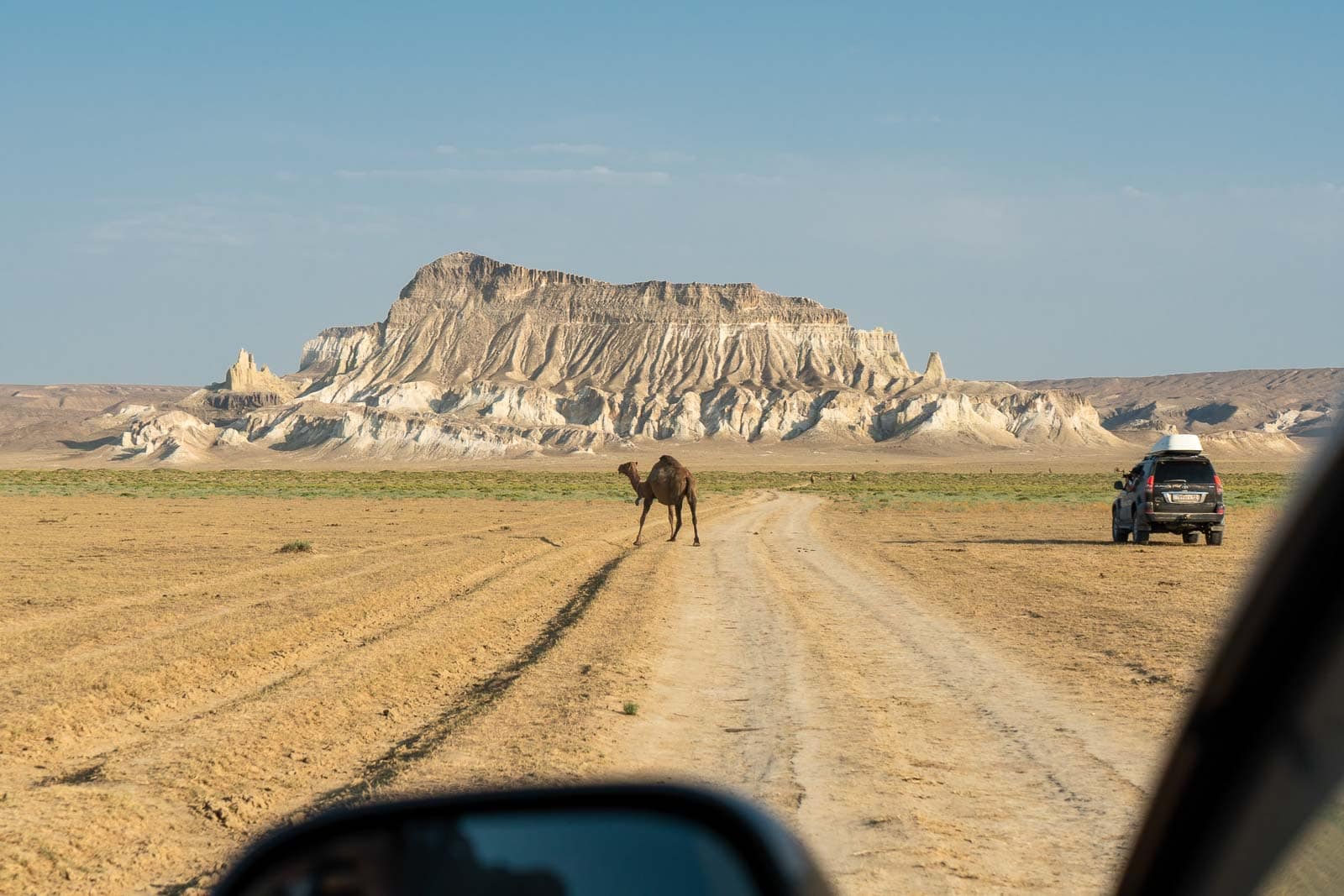
The bad: it means you have to work a bit harder to come up with a plan because you can’t just rely on the same route that everyone does.
The good: it gives you some flexibility to create a specific itinerary that fits your timeframe and interests.
For my trip, I used this company that does a very good three-day tour in Mangystau. But there are some other good options here, depending on how long you’ve got and if you would prefer a private tour:
Each of them is slightly different, but I think three days is the best length for a trip to see the highlights. With that in mind, here’s a good framework for a comprehensive three days in Mangystau.
Day 1: Northward into the Central Steppe
Leaving Aktau, you’ll northeast into the central plains, grouping together the iconic rock formations and historical sites of the central hub before the roads disappear entirely. You’ll cover roughly 200 kilometres, mostly on paved roads with some off-road detours, highlighted by the bizarre stone spheres of Torysh, the fortress mountain of Sherkala, and the layered peaks of Airakty.
Day 2: Down to the Deep South
Cutting south across the Ustyurt Plateau, you’ll see the region’s most dramatic sedimentary landscapes together in a logical sequence along the southern off-road trail. It involves around 250 kilometres of driving, with some longoff-road sections, but you’ll cover the highlights of the Tuzbair Salt Flat and the pastel stripes of Kyzylkup.
Day 3: The Climax and the Coastal Return
The crown jewel of the region is Bozzhyra and that’ll be the focus this morning from different perspectives. Making the long journey back west to the Caspian coast, you can break up the 300 kilometres with the important sacred site of Shopan-Ata.
Now, in a bit more detail, this is what you can expect to find on a good three days in Mangystau itinerary.
Day 1
Into the Central Steppe
Leaving Aktau behind, the paved roads quickly give way to the vast, dusty expanse of the Mangystau region. This first day is all about transition, moving from the shores of the Caspian Sea into the heart of the steppe.
The Torysh Valley of Balls
Scattered across a wide, undulating plain, the Torysh Valley of Balls looks like the abandoned playground of a giant.
Thousands of spherical rock formations, some as large as cars, litter the landscape. Geologists believe these concretions formed millions of years ago as minerals hardened around something like a shell or a fossil.
This is a really interesting site in Mangystau but it’s also one that’s commonly skipped on some multi-day itineraries (including mine) because you need to leave Aktau on a different highway to add it in, which takes more time. But it is popular for the one-day trips.
Sherkala Mountain
Rising abruptly from the flat plains like a colossal yurt or a sleeping lion, Sherkala Mountain is an arresting sight.
This solitary limestone peak isn’t just a geological marvel, it’s also a site steeped in history. In the Middle Ages, a fortress was carved directly into its upper slopes to serve as a defensive stronghold along the northern Silk Road.
Legend has it that the fortress was virtually impregnable, only falling after a prolonged siege when attackers tunnelled through the rock to cut off the defenders’ water supply in the deep well below.
Airakty-Shomanai Mountains
Often called the Valley of Castles, the Airakty-Shomanai Mountains present a dramatic skyline of sheer towering mesas. From the valley floor, the eroded limestone pillars look like the battlements of ruined fortresses and you can scramble up some of them for great views.
One of the best vistas is from the end of the valley, so you call look back across the whole basin. Up here, you can trace the distinct coloured bands of sedimentary rock that stripe the cliff faces, a visible timeline of ancient oceans.
When I was there near sunset, I saw a herd of horses gallop over the ridge, adding a burst of life to the otherwise silent monumental landscape.
Yurt camp in Shetpe
Some tour groups will camp at the Airakty-Shomanai Mountains. But others (including mine), will drive to the nearby town of Shetpe, where there’s a yurt camp on the outskirts.
Inside, the yurts are surprisingly spacious, with heaters to keep them warm and several comfortable beds. Bathrooms and toilets are in communal blocks shared by multiple yurts.
The dining room (yurt) is a friendly space where you might meet other travellers sitting around the table. On my trip, we had a great feast for dinner that included beshbarmak, the national dish of Kazakhstan that has slow-boiled meat (in this case, horse) served over wide flat noodles.
Day 2
The Deep South
Leaving the central steppe behind, the second day of this Mangystau itinerary plunges you deep into the true desert of the Ustyurt Plateau.
Tuzbair Salt Flat
The descent towards the Tuzbair Salt Flat (Sor Tuzbair) is one of Mangystau’s most striking reveals.
First, you arrive at the edge of massive jagged limestone cliffs that plunge dramatically down to a blindingly white expanse of salt, where the pan seems to stretch to the horizon.
Then, as you drive along, you can see the weathered gouges of the pale cliffs that almost look like columns from an ancient temple. Every kilometre you go, there are new shapes along the cliffs on one side, and endless white on the other.
You’ll stop somewhere on the pan – for my group, this was our lunch stop – which gives you a chance to walk up to the cliffs and maybe climb over some of the flowing rock formations.
Kyzylkup (Tiramisu Canyon)
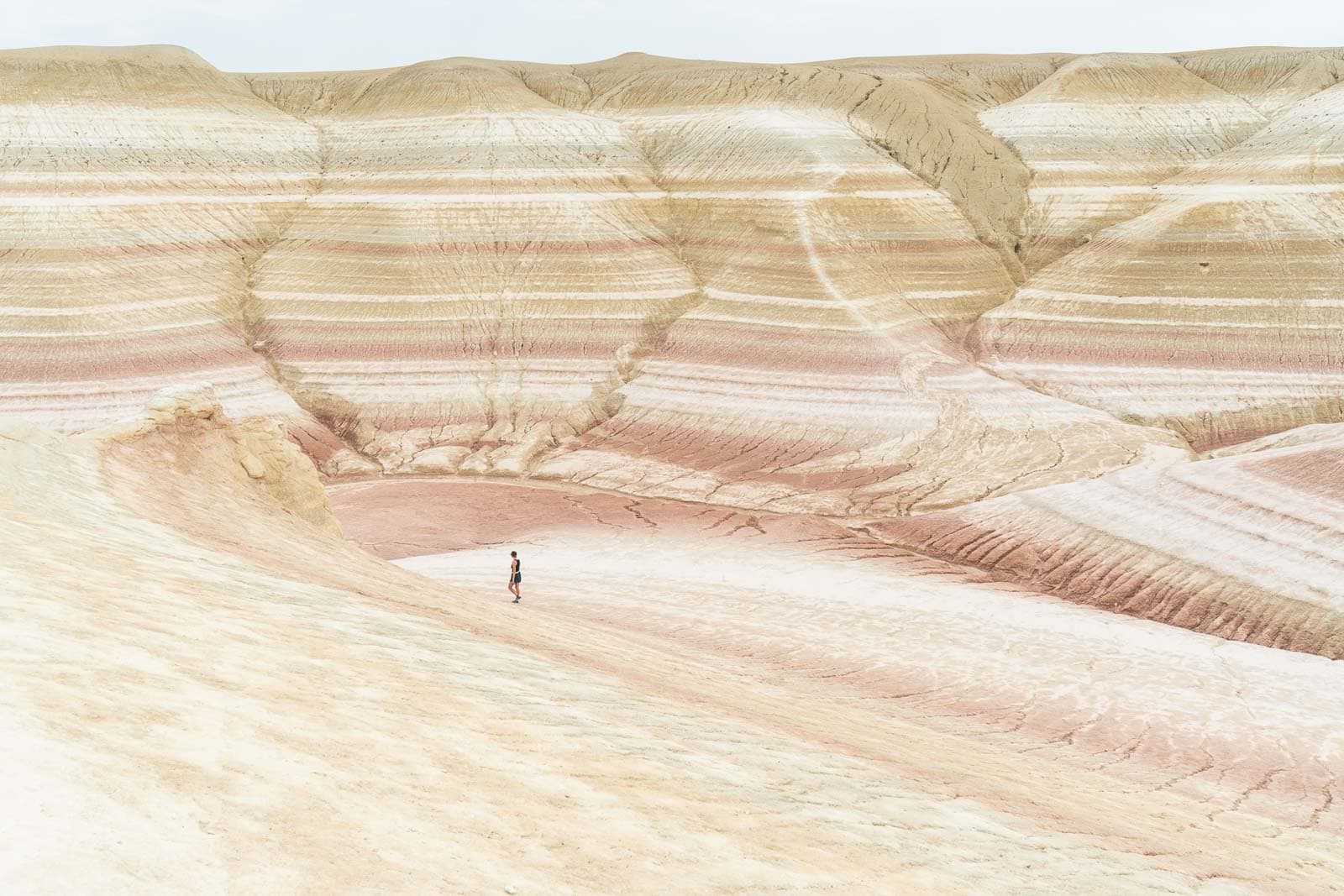
Nicknamed ‘Tiramisu’ for obvious reasons, Kyzylkup is a spectacular display of geological pastry. The hillsides here are perfectly striated with alternating bands of deep red, chalky white, and earthy brown rock. These striking sedimentary layers were laid down over millions of years at the bottom of the ancient Tethys Ocean, later exposed by receding waters and relentless wind.
Walking through the shallow canyons, the vibrant colours seem to shift and intensify depending on the angle of the sun, offering a brilliant, warm contrast to the pale limestone that dominates much of the surrounding desert.
Mount Bokty
Standing alone on the dried clay of an ancient seabed, Mount Bokty is a geological anomaly. Unlike the sprawling plateaus of the region, Bokty is a perfectly symmetrical, steep-sided trapezoid, looking almost like an artificial monument. It features the same striking sedimentary stripes as Kyzylkup, with a prominent band of red chalk cutting sharply through the pale rock.
From the base, the sheer scale and precise geometry of the mountain are mesmerising. It’s such an iconic, distinct formation that it even features on the back of the 1,000 Kazakhstani Tenge banknote, standing as a proud emblem of the region’s unique topography.
Arriving at the Bozzhyra Tract
The drive deep into the Ustyurt Plateau culminates with the arrival at the Bozzhyra Tract, the undisputed crown jewel of Mangystau. As the 4WD navigates the final dusty descent, the valley opens up to reveal a sprawling amphitheatre of colossal limestone formations rising from the basin floor.
This is where most multi-day tours set up camp for the night. Pitching a tent in the shadow of these massive, weathered monoliths provides an unparalleled sense of scale and isolation. As the afternoon shadows lengthen, the pale rock glows with a soft, warm hue, setting the stage for the next morning’s spectacle.
Day 3
The Climax
The final day begins with the undisputed climax of the entire expedition, watching the sun rise over Mangystau’s most iconic panoramas. From the dizzying heights of the plateau rim, the journey then turns back west, tracing a long, dusty route through ancient spiritual sites before civilisation finally reappears.
Sunrise at the Bozzhyra Fangs
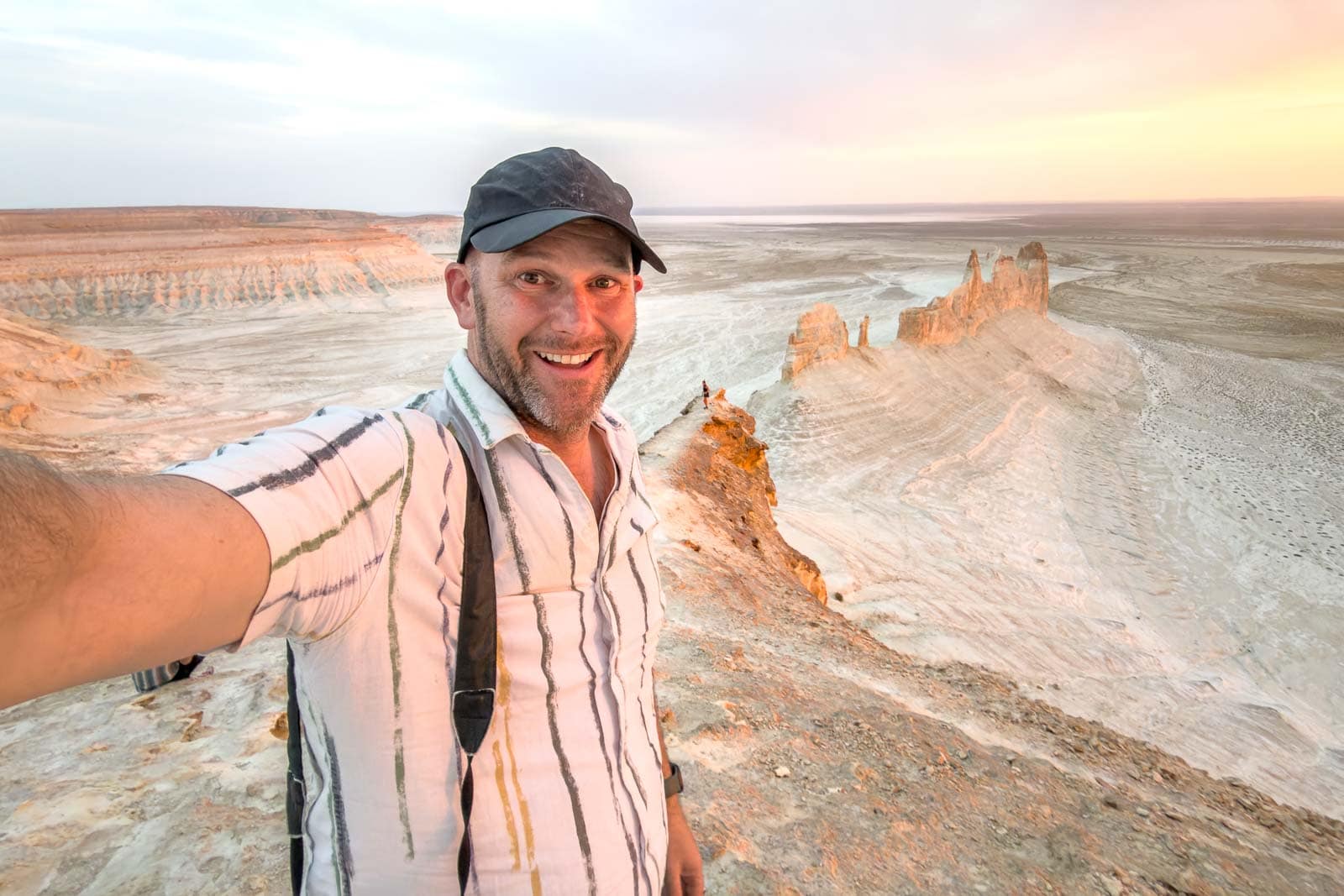
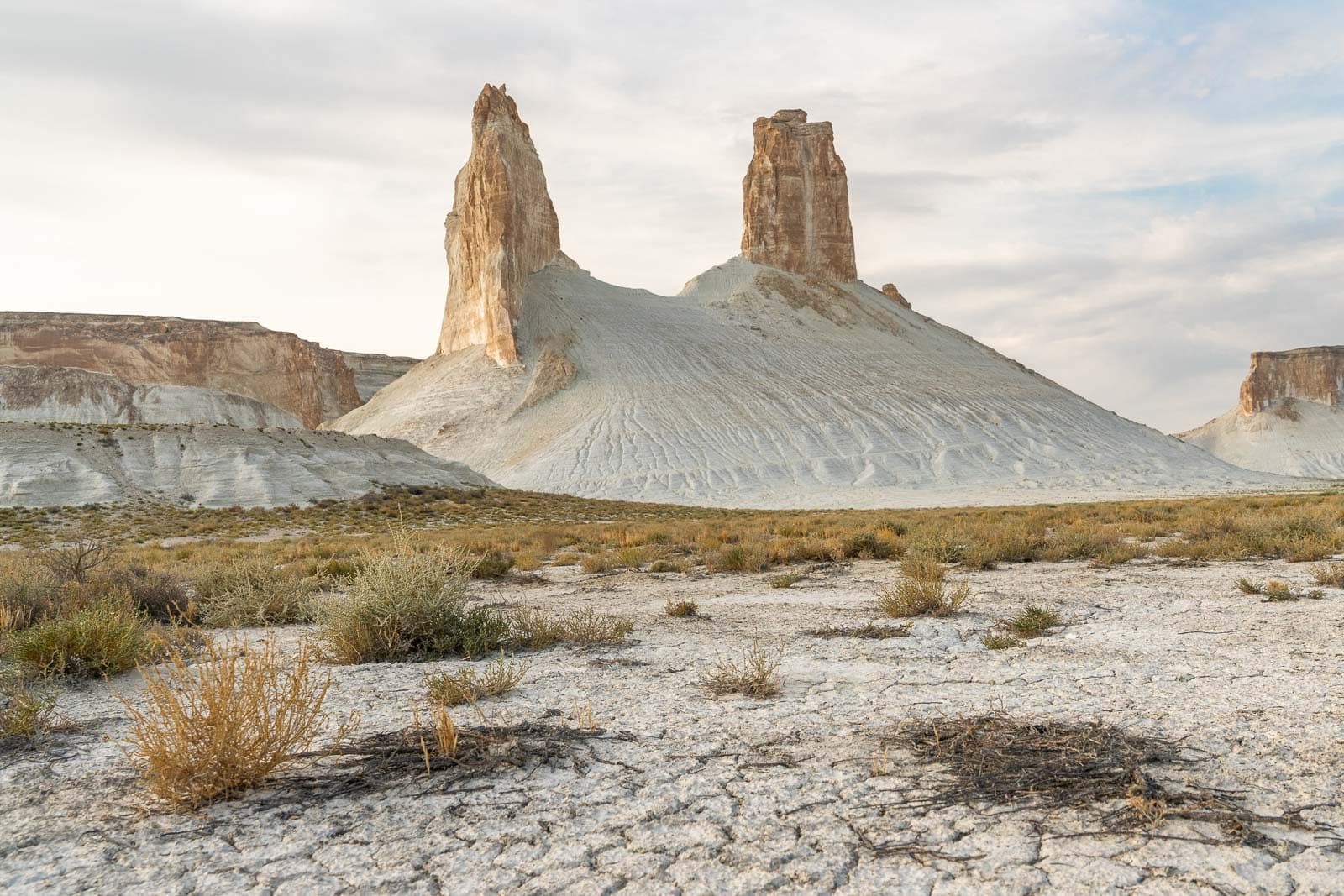
Waking up before dawn is mandatory here. The short hike up to the viewpoint is rewarded as the first light crests the horizon, illuminating the Bozzhyra Fangs. These two towering, sheer limestone pinnacles jut aggressively out of the valley floor, resembling the teeth of some ancient beast. In the soft, golden hour light, the texture of the weathered rock is beautifully defined, and the surrounding basin is painted in subtle pastels.
By midday, the harsh desert sun flattens the landscape and washes out the colours, making this early morning vigil the absolute best time to capture the sheer drama of the fangs.
The Mars Panorama
Before turning back north, there’s one final vantage point to take in. Standing on the edge of the Ustyurt Plateau at the ‘Mars Panorama’, the ground simply drops away, offering an uninterrupted, sweeping view over the entire Bozzhyra depression.
From up here, the jagged peaks, deep canyons, and winding dry riverbeds look distinctly extraterrestrial. You can see the full expanse of the ancient seabed, traced with the white dust of evaporated salt. It’s a dizzying, humbling perspective that perfectly encapsulates the harsh, otherworldly beauty of Mangystau before you finally begin the long journey back.
Shopan-Ata
Breaking up the return journey, the Shopan-Ata necropolis offers a fascinating dive into the region’s spiritual heritage. This ancient underground mosque is carved directly into a rocky outcrop, said to be founded by a 12th-century Sufi mystic.
You can explore the cool, dimly lit chambers hollowed out of the stone, including prayer rooms and the central tomb. Surrounding the cliff face is a sprawling cemetery dotted with hundreds of centuries-old stone markers, their intricate carvings slowly weathering away in the harsh desert wind. It’s a quiet, reflective site that grounds the spectacular landscapes in human history.
The return to Aktau
The final leg of the journey is a stark reminder of the sheer distances involved in exploring Western Kazakhstan. The rugged, bone-rattling off-road tracks eventually give way to smooth asphalt as the 4WD barrels back towards the coast.
Watching the wild, empty steppe slowly transition into the industrial outskirts of Aktau is a jarring experience. After days of total isolation, silence, and sleeping under the stars, the sudden reappearance of traffic, streetlights, and mobile service feels almost abrupt, marking a sudden end to an expedition into one of the most remote corners of the world.
Practicalities for a 3-Day Mangystau Itinerary
If you’re planning to tackle the Mangystau region, Aktau is your inevitable starting point. While it’s a reasonably well-connected coastal city, organising a deep desert expedition once you’ve simply rocked up at your hotel can be a frustrating exercise.
There are local drivers and agencies in town, but language barriers, varying safety standards, and limited availability during the short spring and autumn peak seasons mean you could easily be left killing time in the city.
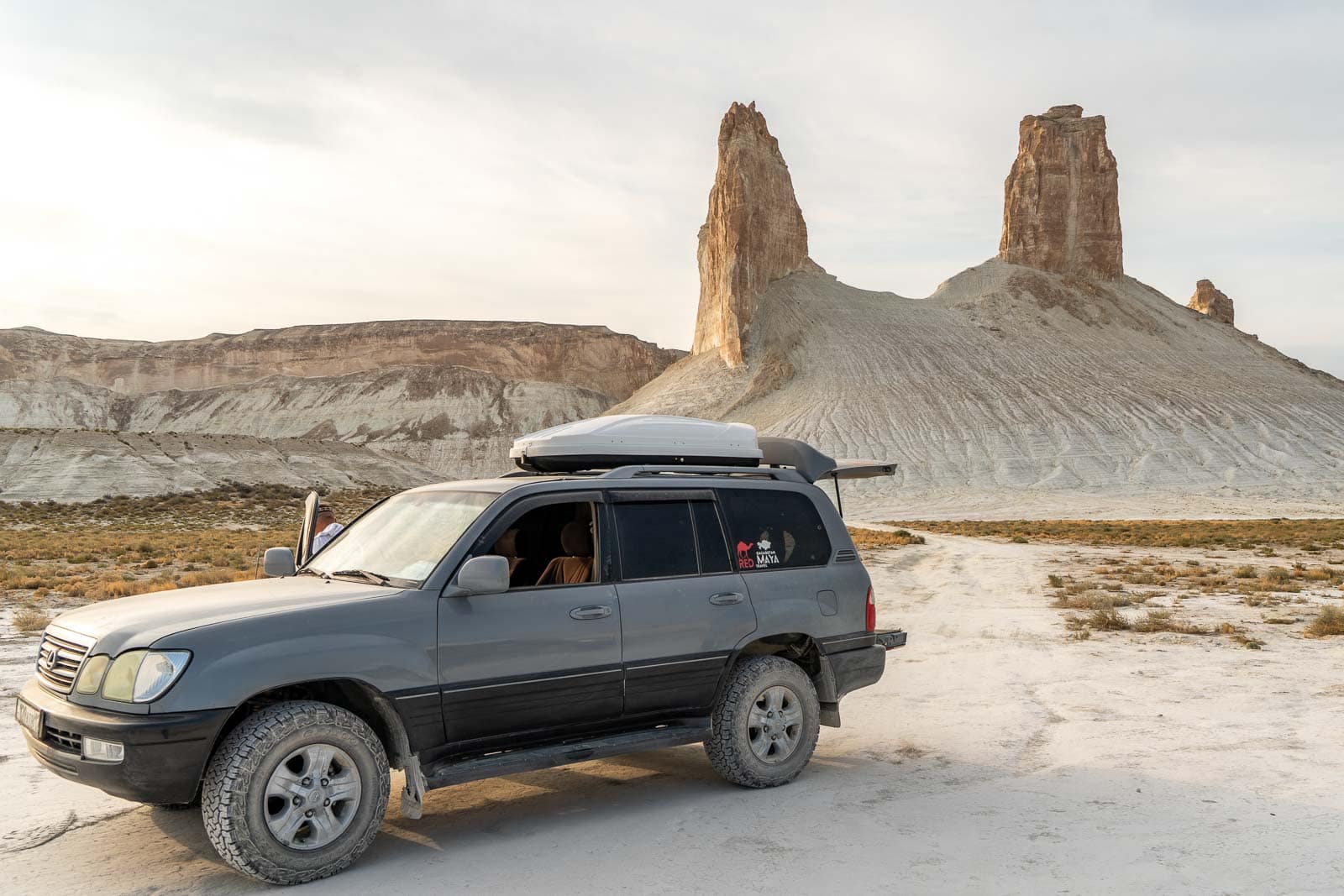
The biggest question most people have is whether they can do this independently. The straight answer is no. Unless you are an expert in off-road navigation, remote mechanical repairs, and desert survival, don’t even try.
Even if you’ve got your own vehicle, the roads simply disappear out in the Mangystau desert. There is zero mobile reception for long periods, and getting bogged in the salt flats or blowing a tyre on the sharp limestone tracks is a very real hazard.
Can I rent a 4WD and drive around Mangystau independently?
It is strongly discouraged unless you are an expert in extreme off-road driving, vehicle recovery, and desert navigation. Paved roads vanish quickly, there is zero mobile reception across vast stretches, and getting bogged in salt flats or blowing a tyre on sharp limestone can turn dangerous very fast.
What are the toilet and sleeping facilities like in the desert?
Accommodation on multi-day trips is usually a mix of traditional yurt camps with basic shared amenities and wild camping in tents under the stars. Toilet facilities in the deep desert are strictly outdoor or drop-pit style, so bring your own toilet paper, hand sanitiser, and a sense of adventure.
Should I book a Mangystau tour in advance or in Aktau?
It is best to book in advance because English-speaking guides and reliable 4WD vehicles are limited, especially during the peak spring and autumn seasons. You can easily compare options and secure your spot ahead of time with one of these tours.
Taking a guided 4WD tour isn’t just the easiest option; it’s really the only sensible one. If you’re genuinely short on time, there are one-day tours that will get you out to the closer sites like the Torysh Valley of Balls or Sherkala Mountain.
Two-day options push a bit further. But to truly experience the staggering scale of the Ustyurt Plateau and reach the Bozzhyra Fangs, a three-day expedition is the absolute sweet spot.
For my trip, I used this company that does a very good three-day tour in Mangystau. But there are some other good options here, depending on how long you’ve got and if you would prefer a private tour:
You can book private expeditions if you have your own group, or join a shared tour to split the costs. The guides provide the rugged 4WDs, handle the intense off-road navigation, and sort out all the camping gear and meals.
It takes the logistical stress entirely out of the equation, letting you focus on the extraterrestrial landscapes rather than worrying about whether you packed enough spare water and tyres.



Artikel bagus! Saya juga nulis tentang kopdestoto di cepatsukses.com. Cek ya!
This 3-day Mangystau itinerary looks like an incredible adventure! From Aktau’s modern architecture to the mystical Baysug and Koylykol, it’s clear Michael Turtle has crafted something truly special. If you’re someone who loves exploring hidden gems, this journey is a must-try. On my quieter days, I enjoy unwinding with MovieSpot—a daily movie guessing game that keeps the mind sharp while sparking nostalgia. Both travel and film challenges offer their own kind of escape. Which destination would you add to this list if you had more time? MovieSpot mystery film challenge